Readiness Thinking Tool: Why Organizational Readiness for Change Matters
By Dr. Sobia Khan, Director of Implementation
Over the past decade, organizations have increasingly focused on the role that readiness plays in their implementation initiatives. This is likely because historically, innovations were rolled out in organizations without really paying attention to contextual factors that can influence adoption, implementation quality, and outcomes. The belief that an evidence-based innovation will work solely because of the existing evidence base is losing steam – we know that we need to implement evidence-based innovations in an amenable context at an amenable time. Organizational readiness for change assessments help us understand whether an organization is ready to receive an innovation at the crucial adoption stage, as well as throughout implementation and sustainability.
What is organizational readiness for change?
The best way to break down organizational readiness for change is by understanding individual readiness for change, which is where this concept is derived from. Imagine any change you have been trying to make in your own life – for example, deciding to commit to exercise at least three days a week. The evidence is clear: exercise is beneficial. You may need to consider your capacity to exercise 3 times a week: how much time you have each day, whether or not you have the right equipment or membership, your physicial ability to exercise in specific ways, your knowledge on how best to exercise. However, the biggest make or break factor is likely going to be how motivated you are to exercise (i.e., whether or not you are psychologically capable of making this commitment and sticking to it). This is the true difference between readiness for change and capacity for change.
Organizational readiness for change is much the same. However, since an organization is made up of multiple individuals, organizational readiness for change is the collective capacities and motivations for change. Not only do organizations require the right knowledge, infrastructure, equipment, etc. for change – the individuals in the organization have to be collectively motivated to make change happen. This is an important point to drive home, because too many organizations that I have worked with equate readiness with structural capacity for change, but not with the psychological capacity for change. Both components need to be understood and explored. To learn more about this distinction, check out this article by Holt and colleagues.
In this issue of Implementation in Action, Dr. Jonathan Scaccia, the Chief Operating Officer of the Wandersman Center, gives us a snapshot of the extensive work his organization has been doing in supporting organizational readiness assessments across the United States.
Readiness Thinking Tool
By Jonathan Scaccia and Ariel Domlyn
First Published: August 21, 2019
Last Updated: April 1, 2026
Why implementation projects fail (and how readiness is related to implementation failures)
Implementation projects fail more than they succeed. Readiness is an essential component for success. What does it take for an organization to be ready to implement a project? An uncomfortable truth in implementation science is that we often make our plans based around the innovation – “the thing” – rather than around the organization that would be implementing “the thing”. Training and materials are developed about the innovation. The organization is often regarded as a vessel. But if the innovation is the seed, then the organization is the soil. Even the best seed won’t grow if the soil is barren, compacted, or depleted.
What is organizational readiness in implementation science?
Organizational readiness is how much a system is ready to implement the innovation. In the R=MC2 framework (Scaccia et al. 2015), we compiled the key elements into an easy-to-remember heuristic (see this article for more details on the heuristic):
Readiness = Motivation x Innovation-Specific Capacity x General Capacity,
or
R = MC^2
The Readiness Building Process: How to strengthen readiness over time
The Readiness Building Process describes step-by-step how to build organizational readiness (Domlyn et al., 2021; Watson et al., 2022). Building readiness isn’t about adding another checklist—it’s about nurturing the conditions where change can take root and thrive. When we focus only on the innovation, we risk missing what truly determines success: the health of the system that’s expected to carry it. Readiness-building activities help organizations see themselves not just as vessels for delivery, but as living systems capable of growth, adaptation, and resilience. When we invest in the soil, the seeds take care of themselves.
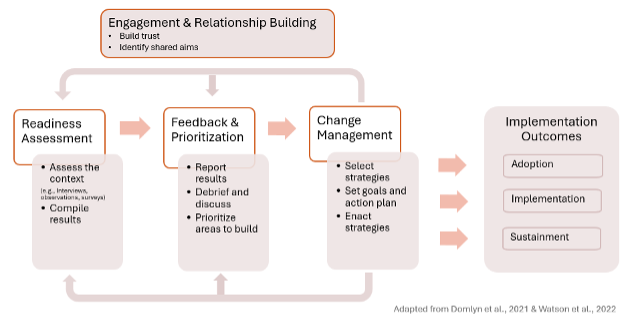
Figure: Updated Readiness Building Process
Ways to assess organizational readiness
Several survey measures have been developed to capture readiness. But it isn’t always feasible to administer surveys, at least not repeatedly, in large or resource-strapped settings. Readiness can naturally change over time and be improved using readiness-building activities. Monitoring whether the organization is, or isn’t, ready is an essential activity for implementation practitioners. Enter the Readiness Thinking Tool.
What is the Readiness Thinking Tool (RTT)?
The Readiness Thinking Tool (RTT) is a one-page worksheet designed to provide a snapshot into 19 readiness determinants (barriers and facilitators). The RTT was conceived to translate the rich, theory-heavy R=MC2 organizational readiness framework into a pragmatic tool for implementation support practitioners at the CDC (Kenworthy et al., 2022).
When our team partnered with the CDC, we used the RTT to keep track of what helped or got in the way of readiness for implementing policies. Rather than a survey or interview guide, the RTT works more like a conversation compass. During regular partner calls, implementation support practitioners listened for clues about readiness—things like motivation, relationships, or available resources—and used the RTT to organize what we were hearing in real time. Most importantly, they rated readiness based on the perspectives of people internal to the setting, especially those routinely delivering the innovation. Internal perspectives didn’t always match the implementation support perspectives!
The Readiness Thinking Tool in practice
The RTT is a tool to help practitioners think clearly and stay focused on the conditions shaping implementation at each site. Because readiness is often changing, the RTT is meant to be used regularly as a check-in on how things are going and what might need to change. In the early days, we completed the RTT monthly, but the real value comes from using it flexibly and often as part of normal technical assistance support routines.
The RTT only captures readiness factors, not the actual strategies teams use to respond to them. For that, it pairs well with tools like the Readiness Action Plan, adaptive logic models, or activity logs. Together, they turn reflection into action and help teams adapt, support, strengthen readiness, and keep implementation on track.
This work matters because lower-resourced settings do not implement as well as those with more resources. This pattern sets up a perpetuating cycle whereby poor implementation contributes to ongoing equity gaps. Across all our work, we try to find methods to help all organizations implement and reach outcomes in their communities. We see readiness as a practical model to facilitate this.
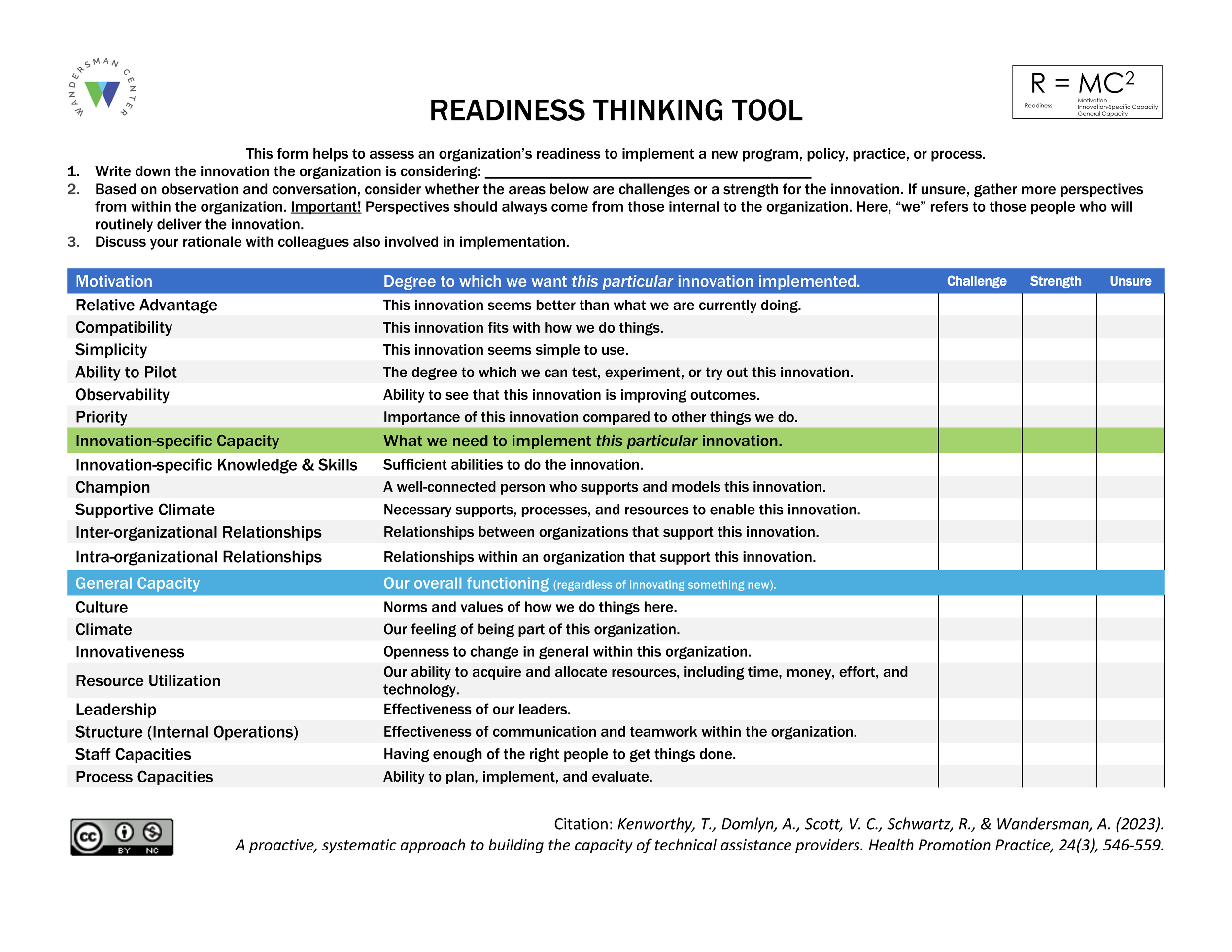
Download the Wandersman Readiness Thinking Tool.
For more information on the Readiness Thinking Tool and Readiness Building Process, see the Wandersman Center.
References
Domlyn, A. M., Scott, V., Livet, M., Lamont, A., Watson, A., Kenworthy, T., ... & Wandersman, A. (2021). R= MC2 readiness building process: A practical approach to support implementation in local, state, and national settings. Journal of Community Psychology, 49(5), 1228-1248.
Kenworthy, T., Domlyn, A., Scott, V. C., Schwartz, R., & Wandersman, A. (2023). A proactive, systematic approach to building the capacity of technical assistance providers. Health Promotion Practice, 24(3), 546-559.
Scaccia, J. P., Cook, B. S., Lamont, A., Wandersman, A., Castellow, J., Katz, J., & Beidas, R. S. (2015). A practical implementation science heuristic for organizational readiness: R= MC2. Journal of community psychology, 43(4), 484-501.
Watson, A. K., Hernandez, B. F., Kolodny-Goetz, J., Walker, T. J., Lamont, A., Imm, P., ... & Fernandez, M. E. (2022). Using implementation mapping to build organizational readiness. Frontiers in public health, 10, 904652.
These articles were featured in our monthly Implementation in Action bulletin! Want to receive our next issue? Subscribe here.
Related Resources
Are you looking for other tools? Check out: