The Context Compass Framework Explained: How to Assess Context Across Levels and Phases of Implementation
By Dr. Sobia Khan, Director of Implementation
7-min read
At TCI, we have been going into the “rabbit hole” of context and have emerged with different ways of thinking about the nuances of assessing and addressing context. Our deep dive led us to develop an advanced tool to select contextual strategies – the StrategEase 2.0 tool – and a brand-new course entirely focused on context, Context at Scale.
What is context in implementation science?
In implementation science, context refers to the conditions, factors, and circumstances — internal and external to a setting — that shape how the THING is implemented. It’s everything that surrounds us. This includes the people involved, organizational structures, resources, leadership, culture, relationships across system levels, and even large-scale events like policy shifts or public health crises.
What is the Context Compass Framework?
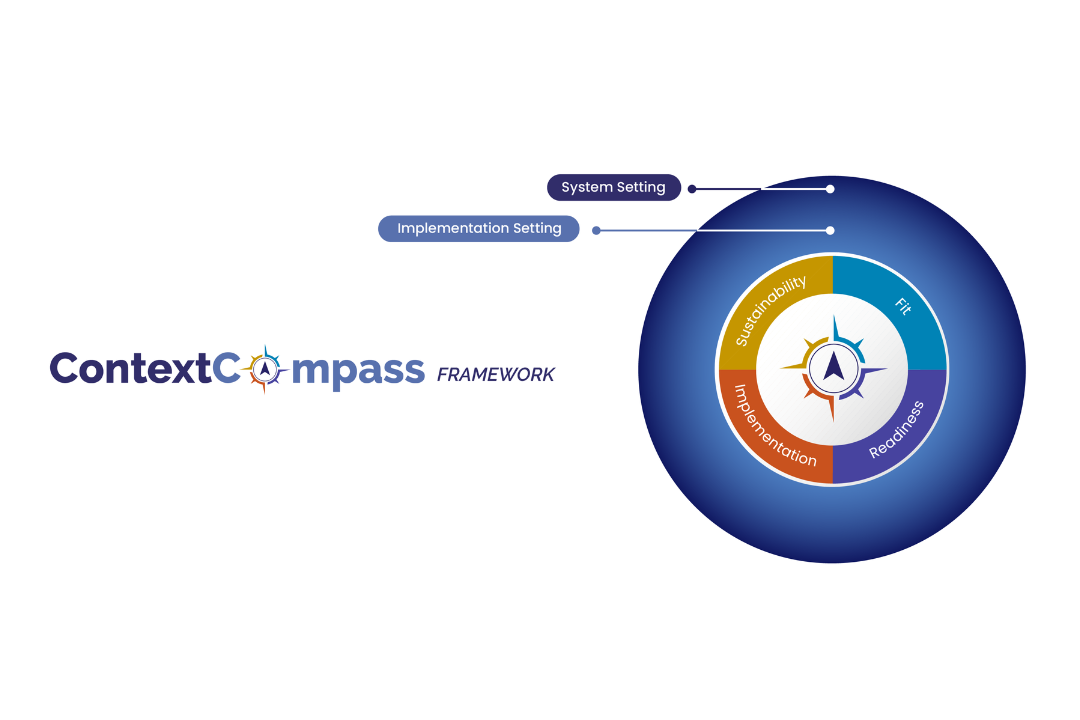
The Context Compass Framework (CCF) is a multi-level contextual assessment framework that maps implementation factors or determinants across levels (setting, organization, inter-organizational, system) and links them to specific implementation phases: fit, readiness, implementation, and sustainability. It's designed to make context assessment not just comprehensive, but purposeful. We didn’t want people to be overwhelmed with a long list of factors, but considering a smaller list that are relevant at multiple levels of the system across the lifespan of implementation.
The StrategEase 2.0 tool and Context at Scale course are based on the Context Compass Framework. We introduced this framework in a previous bulletin on making context assessment manageable. Here, we go further, unpacking the framework in more detail.
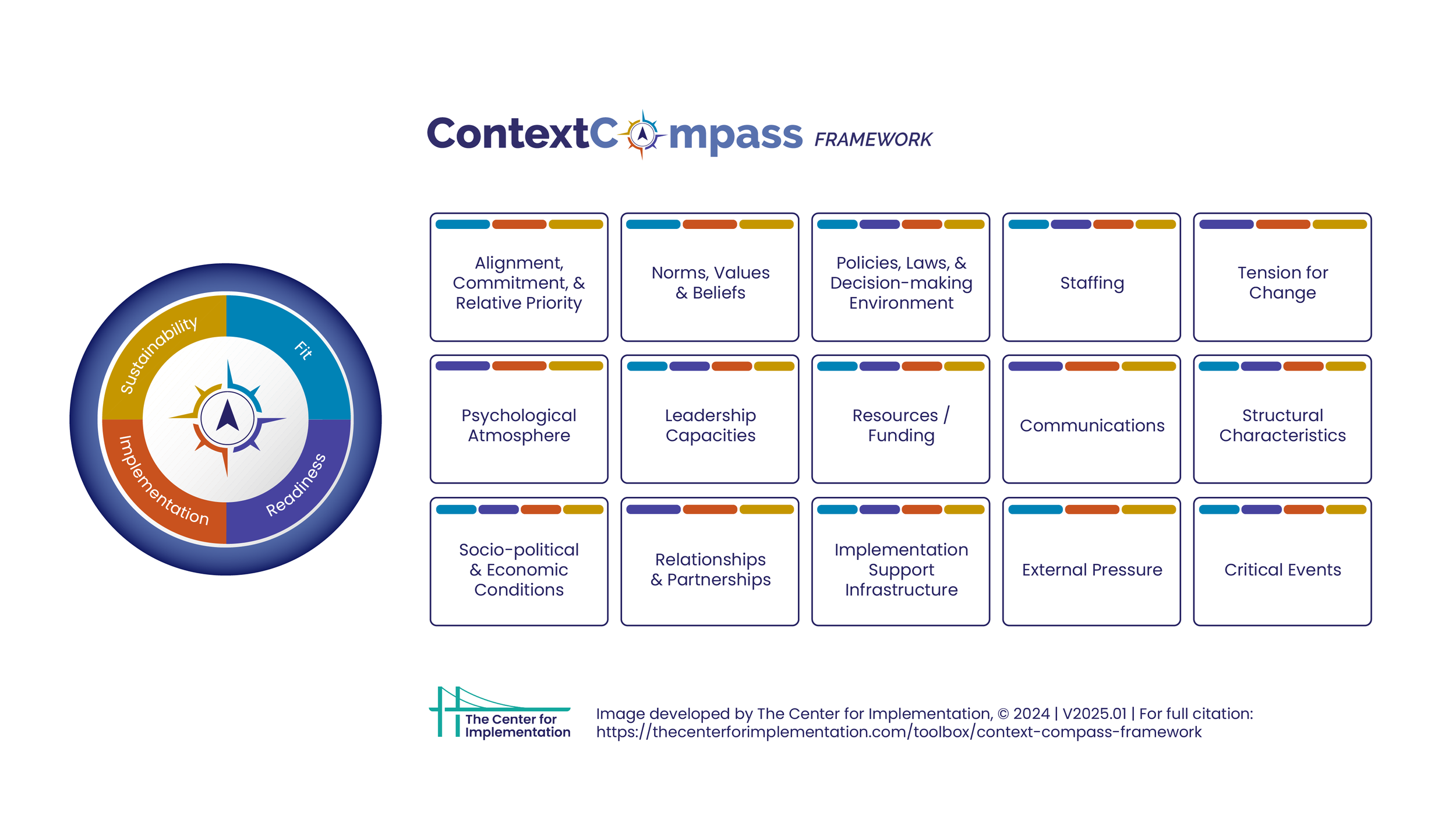
Common examples of contextual factors at multiple levels
The CCF captures context at multiple self-defined levels, acknowledging that there isn’t just an “inner” and “outer” context, but that several levels of context may be impacting implementation. Rather than having separate lists of factors that define context at these levels, the CCF factors can operate at each of these levels. Some common examples that we have seen in our support work include:
CCF Factor: Staffing
Many organizations are facing staffing issues, whether it is staff turnover, the availability of certain types of staff, or overall staff capacity to implement. Inter-organizationally, these challenges may still be relevant; for example, having dedicated staff to work across inter-organizational work groups when each participating organization lacks staff capacity.
At the system level, staffing challenges might look slightly different. Often, when people discuss staffing within systems, they refer to whether the right professional cadre is available or whether there is a need to build the capacity of human resources.
CCF Factor: Critical events
Critical events are important, disruptive occurrences that can help or hinder implementation. Often, people think about system-level critical events, such as a pandemic or forest fires (or both at the same time, which is something we have seen in our support work).
Critical events can also happen at a setting level, for example, flooding within a building that impacts structural characteristics, workflows, etc. Fans of the TV show “The Pitt” will recognize that critical events are constantly impacting the emergency department, some of them a big community issue (e.g., a mass shooting) and others that just affect the setting (e.g., a cyber-attack).
CCF Factor: Tension for change
Tension for change refers to the deep collective feeling that something needs to be different from the status quo, even if it can’t be pinpointed exactly what needs to change. Organizations that invite change into their settings often do so because of this collective tension for change. This feeling can be felt at larger collective levels; for example, a tension for change is often the basis of social movements. Policy and decision makers might have differing tensions for change than others in the system – they are ready to move on to implementing something, while the implementing settings do not feel the same way, creating conflicts across a system.
These are just a few examples of how the CCF factors can be interpreted and applied at multiple levels. By developing a set of multi-level factors, we achieve two things: 1) we expand our list of relevant system-level factors, which tend to be lacking in determinant frameworks rooted in implementation science, and 2) we start thinking about context in ways that align with complexity and systems science. Note in the examples above that not only is context considered at multiple levels, but the interrelationships and dependencies between factors also become apparent.
Linking context to implementation phases: Fit, readiness, implementation, and sustainability
An additional unique aspect of the CCF is that contextual determinants are not just listed as a set of factors, but are also linked to an underlying purpose of sensemaking around context. In high-quality implementation, we aren’t just doing general context assessments; we are trying to make sense of what the contextual determinants are doing (e.g., making something a bad fit, making a setting unready, making implementation unsustainable) through specified assessments.
The CCF flags factors that primarily relate to four different implementation “phases”. We use the term “phases” here loosely, as these are not necessarily meant to depict a linear process: fit, readiness, implementation, and sustainability. For example, we described the factor “tension for change” above. This highly relates to readiness assessments because we often see that readiness is more palpable when a tension for change exists. This is not highly related to fit assessments because something could fit perfectly in a setting, but may not be implemented if there is no tension for change.
Why TCI built a new contextual framework and what makes the CCF different
In all honesty, we didn’t plan to build a new framework (we know there are so many already). The original intention of our work on context was to understand how to select contextual strategies, but the journey led us to develop our own framework to capture how we think about context. After developing and refining the CCF over the past 3 years, we feel that producing the CCF was the right call. Context is complex, and a framework that explains why it is complex while also helping people manage that complexity is warranted in implementation science and practice.
Frequently asked questions about context assessments
What is a context assessment in implementation science?
In implementation science, context refers to the conditions, factors, and circumstances — internal and external to a setting — that shape how the THING is implemented. It’s everything that surrounds us. This includes the people involved, organizational structures, resources, leadership, culture, relationships across system levels, and even large-scale events like policy shifts or public health crises.
What is the Context Compass Framework?
The Context Compass Framework is a multi-level contextual assessment framework that maps implementation factors or determinants across levels (setting, organization, inter-organizational, system) and links them to specific implementation phases: fit, readiness, implementation, and sustainability.
What's the difference between inner and outer context?
Inner context refers to factors within the implementing setting itself, such as organizational culture, staffing capacity, and leadership. Outer context refers to factors in the broader environment, including system-level policies, interorganizational dynamics, and large-scale events such as funding shifts or public health crises. In the Context Compass Framework, we refer to these as the setting and system levels.
How is the Context Compass Framework different from the CFIR?
The CFIR is a foundational context framework that we used as a starting point for the CCF. The CCF builds on the CFIR by also incorporating factors from 12 contextual frameworks. The CCF takes the CFIR further by explicitly linking contextual factors to implementation phases (fit, readiness, implementation, sustainability) and by highlighting the same factors that can be considered across multiple levels (i.e., using the same factors at the setting and system levels).
Conclusion
At TCI, we believe understanding context isn't just an academic exercise — it's the foundation for knowing what's actually happening where you're implementing, and what to do about it.
If you're ready to go deeper, the Context at Scale course walks you through how to assess context with purpose across levels and phases using the CCF. It's a particularly practical way for teams to build shared language and capacity together — group enrollment is available if you're looking to bring your team along.
Once you know what you're working with, the StrategEase 2.0 tool (available May 2026) helps you select the right contextual strategies to move forward.
This article was featured in our monthly Implementation in Action bulletin! Want to receive our next issue? Subscribe here.