TCI’s Adapted Theoretical Domains Framework (TDF): What Changed and Why
By Dr. Julia E. Moore, Executive Director
7-min read
The Theoretical Domains Framework (TDF) is a widely used implementation science and behavior change framework that supports the identification of individual barriers and facilitators to change. Originally developed by psychologists in the UK (Cane et al., 2012), the TDF is embedded in the larger Behaviour Change Wheel (Michie et al., 2011) and has become a cornerstone in implementation science and change efforts across health, education, and social sectors.

We have actively been using the TDF to map individual-level barriers and facilitators since 2014. Over the past decade, we have had many reflections, discussions, and feedback about the TDF domains. As we started building an updated version of the StrategEase tool, StrategEase 2.0 Advanced tool, we realized this was the right time to make adaptations to the TDF based on everything we have learned over the past decade.
To learn about the original TDF, you can read the article, What is the theoretical domains framework (TDF)? Here we describe why we made these adaptations to the TDF, what stayed the same, and what changed.
Note: Our original TDF image already used slightly adapted language for some domain titles, though all 14 original domains were kept. This new adapted version involved simplifying domain names, separating constructs that were grouped together, and removing constructs that weren't capturing barriers or facilitators.
Why did TCI adapt the Theoretical Domains Framework?
The TDF is one of the most widely used frameworks in implementation science, particularly for mapping individual-level barriers and facilitators as it is grounded in behavioral science. After using it regularly for a decade, we have noticed where practitioners get stuck, get confused, or ask the same questions over and over. Plus, our understanding of the interaction between individual and contextual factors has changed over the past decade, leading us to view some of the TDF domains differently.
We wanted to build on the TDF’s solid foundation, focusing on making it as usable as possible for our audience, implementation teams, professionals, and researchers looking to use it to inform implementation efforts. That involved simplifying domain names that were causing confusion, separating constructs that were being conflated, and removing constructs that weren’t tapping into barriers and facilitators.
What changed in TCI’s adapted TDF?
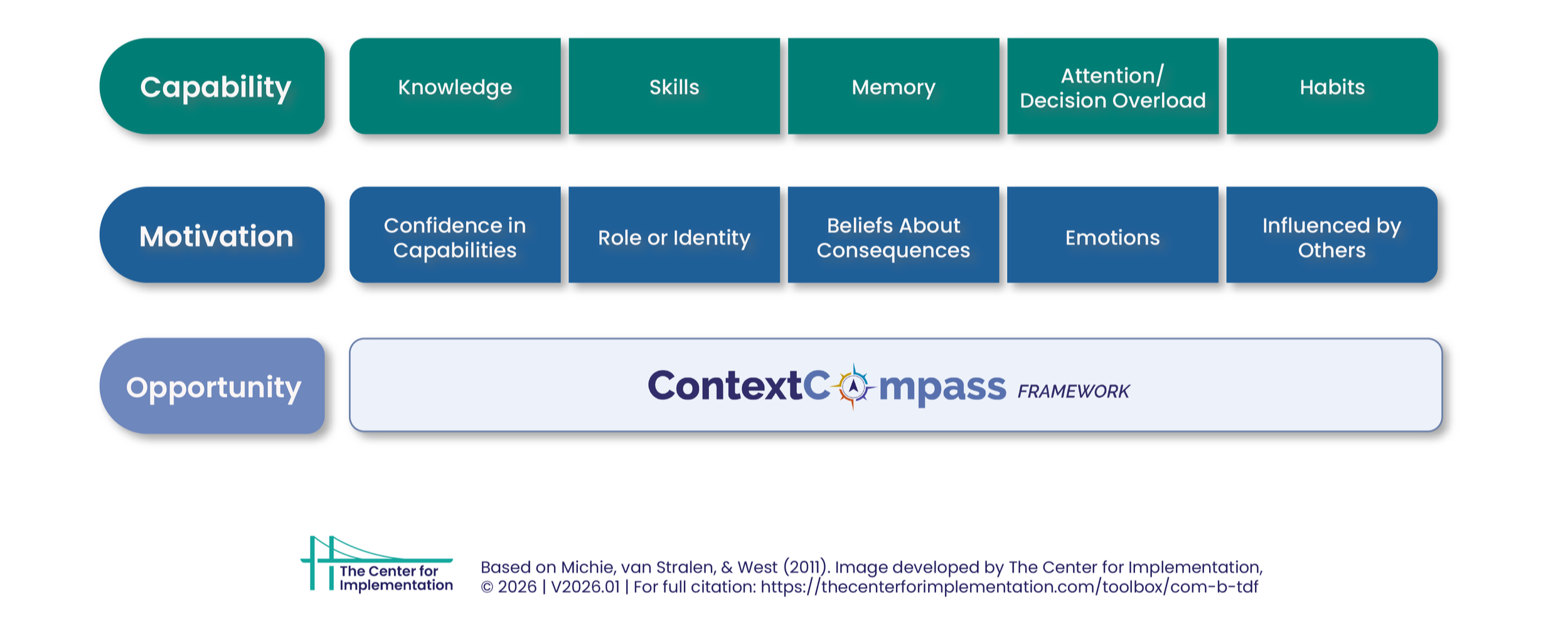
The TDF domains are designed to expand on the capability, opportunity, and motivation components of the COM-B model. In the adapted TDF, the capability and motivation categories remain, but several domains within them have been renamed, split, or removed to reduce confusion and better reflect what we have learned in practice. The opportunity domains have been removed entirely; rather than try to expand on a category that was always quite general, we now rely on dedicated contextual frameworks, such as the Context Compass Framework or the Consolidated Framework for Implementation Research, to capture environmental and contextual barriers and facilitators. Below, we walk through what stayed the same and what changed within capability and motivation, starting with the domains that remained untouched. The table below outlines the adaptations to each of the TDF domains.
Table comparing the original and adapted TDF domains
| COM-B Category | Original TDF Domain | Adapted TDF Domain |
|---|
| Capability | Knowledge | Knowledge |
| Capability | Skills | Skills |
| Capability | Memory, Attention, and Decision Processes | Memory |
| Capability | Memory, Attention, and Decision Processes | Attention / Decision Overload |
| Capability | Behavioural Regulation | Habits |
| Motivation | Beliefs About Capabilities | Confidence in Capabilities |
| Motivation | Social/Professional Role/Identity | Role or Identity |
| Motivation | Beliefs About Consequences | Beliefs About Consequences |
| Motivation | Emotions | Emotions |
| Motivation | Optimism/Pessimism | (removed — folded into Emotions) |
| Motivation | Goals | (removed) |
| Motivation | Intentions | (removed) |
| Motivation | Reinforcement | (removed) |
| Opportunity | Environmental Context and Resources | (removed — see contextual frameworks) |
| Opportunity | Social Influences | Influenced by Others (moved to Motivation) |
Which TDF domains stayed the same?
Several domains have remained the same between the original TDF and the adapted TDF. Within the COM-B capability category, two domains have remained the same: knowledge and skills.
Knowledge: The awareness of something and understanding key information about it.
Skills: The ability to do something, based on practice, learning, or experience.
Under the COM-B category of motivation, there are also two domains that remained the same: beliefs about consequences and emotions.
Beliefs about consequences: What someone thinks will happen if they do (or don't do) something.
Emotions: The feelings that occur when someone is presented with or does something.
Reimagining the connection between “Opportunity” and contextual frameworks
In implementation science, it has become fairly common practice to use the TDF as an individual-level behavior change framework and use a separate framework to capture the contextual barriers and facilitators. The original TDF included two domains under "opportunity." One of them, environmental context and resources, essentially describes the totality of some of the contextual factors that people talk about in implementation. Instead of using one domain that really needs to be fleshed out with an entirely different framework, we thought it would be most helpful to illustrate how the TDF can work in conjunction with other frameworks that unpack the contextual-level barriers and facilitators, like the Context Compass Framework or the Consolidated Framework for Implementation Research (CFIR).
Why is "Memory, Attention, and Decision Processes" split into two domains?
When teaching people about the TDF, it is relatively easy for people to conceptualize the concept of memory as a barrier or facilitator to change. On the other hand, thinking about attention and decision processes is something we have found people struggle with much more. When these three constructs were combined into one domain, our experience has been that people focus almost exclusively on the memory aspect of this domain, ignoring the fact that attention and decision processing can also drive behavior. Therefore, to highlight the role of attention and decision processes, we decided to split this into two different domains — each capturing a component of the previous domain — so that the totality of the previous domain is captured across the two.
Memory: The ability to retain and remember information when it's needed.
Attention / Decision Overload: The ability to focus selectively on or be decisive about something.
Why did we rename "Behavioural Regulation" to "Habits"?
While the original domain of behavioural regulation is broader than habits, our experience has been that professionals have struggled to understand what falls within it. Once we describe this as habitual behaviors, it's like a lightbulb goes off, and people can imagine the habitual behaviors that might be influencing their goals. Therefore, we renamed this domain to make it more accessible to practitioners.
Habits: A practice or behavior that someone often does automatically/without thinking about it.
Why did we rename "Beliefs About Capabilities" to "Confidence in Capabilities"?
When describing this domain, people have frequently struggled to understand it. Once we start highlighting that this is about people's confidence in their capabilities, rather than the actual skills they have, many people can see the distinction. Therefore, we renamed beliefs about capabilities to confidence in capabilities.
Confidence in Capabilities: Someone's belief in their ability to do something.
Why did we rename "Social/Professional Role/Identity" to "Role or Identity"?
Honestly, social/professional role/identity is a very long domain title. Plus, people have often asked questions about the difference between a social and a professional role. When we simplified it to being about people's roles or identities, they tend to understand what we are talking about. Therefore, we simplified the domain name.
Role or Identity: Someone's beliefs or thoughts about their personal, professional, or social qualities and characteristics.
Why did we remove the domains of “Goals”, “Intentions”, “Reinforcement”, and “Optimism”?
Whether behavior was a goal or intention has always been interesting in relation to implementation, but it also felt like something slightly different from the other identified barriers and facilitators. Having an intention or a goal is not quite the same as the other barriers and facilitators, which tend to be pre-existing capabilities and motivations. These link to the stages of change, more like objectives that people have as they contemplate and then plan to change. Supporting people to change means, for example, wanting people to make something a goal and set it as an intention, and if we are able to do that, it might increase the likelihood that they can successfully implement. But that is not quite the same as the other barriers and facilitators that we are capturing and classifying. Therefore, we removed these from the adapted TDF.
Reinforcement has a similar relationship: it is important to know whether new behaviors are being reinforced or if the old ones are being reinforced, but that is less of a pre-existing barrier or facilitator and more of an assessment of what is happening once people start implementing changes.
Finally, Optimism (which we had previously renamed Optimism/Pessimism) — is one we have consistently gotten questions about. People asked how it differs from the domain of Emotions, since being optimistic or pessimistic about a change is an emotional reaction. Therefore, we have collapsed this into the broader domain of Emotions.
Why did we rename "Social Influences" and move it to the Motivation category?
We found that a small wording change – from 'social influences' to 'being influenced by others' – really helped clarify this domain for practitioners. For example, practitioners are applying this in a work setting and might be influenced professionally (so do not see it as a “social” influence). Since we first started using the TDF, we and many others have questioned whether this domain should also play a role in the motivation category. That's because people's motivation is often influenced by the behavior of others — for example, by peer behavior, the behavior of managers, supervisors, or other leaders, by what is happening in the community, social media, the public, or public perception. We have also learned about the interesting connections between factors that influence trust and those that influence motivation, highlighting the role of social influences on people's motivation.
Note that this continues to play a role in the category of opportunity, but that is addressed by several different factors in the contextual frameworks that people can use.
Influenced by Others: How other people's expectations, interactions, and behavior shape someone's behavior.
How the adapted TDF is embedded in StrategEase 2.0: Advanced tool
Our original StrategEase 1.0: Foundational tool continues to use the original TDF and will be updated at some point in the future. However, the adapted version of the TDF is built into the StrategEase 2.0 Advanced tool, which walks you through mapping your barriers and facilitators and selecting strategies that match. You can also use the tool to explore strategies to address contextual barriers and facilitators using the Context Compass Framework.
Summary of the adapted TDF
Overall, the adapted TDF builds on the original TDF, with an emphasis on making it more accessible to practitioners. We tried to focus on usability: domain names that caused confusion have been simplified, constructs that were getting lost within larger domains have been separated out, and domains that captured something other than barriers and facilitators have been removed or repositioned. While the original is more sound from a behavioral science perspective, the adapted version is an option for those who are looking to apply and describe theory in a more straightforward way.
This article was featured in our monthly Implementation in Action bulletin! Want to receive our next issue? Subscribe here.