Principles-Based Implementation: What It Is and Why It Matters
By Dr. Sobia Khan, Senior Director
5-min read
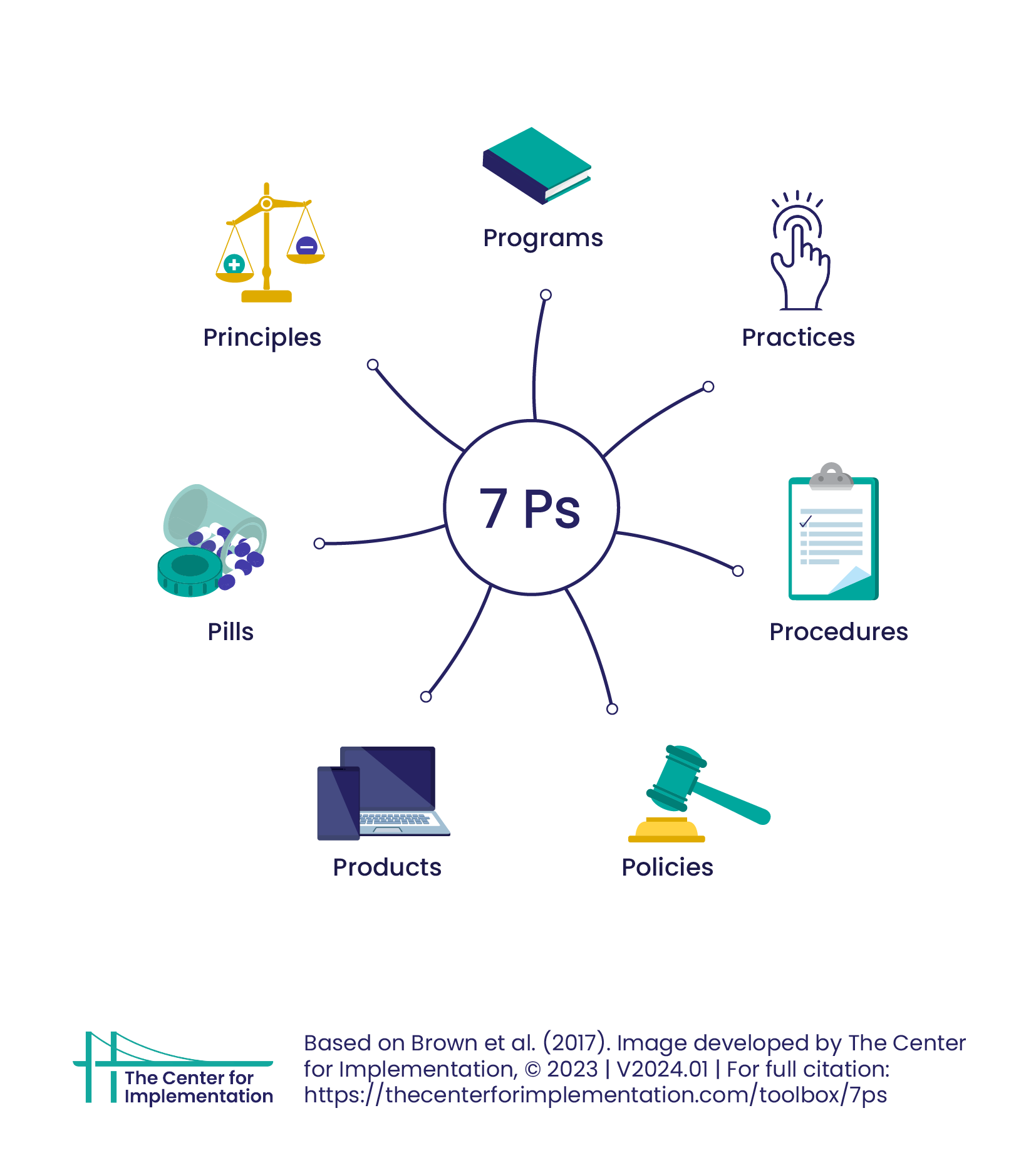
I recently attended a conference in which many presenters were using TCI-developed images from TCI’s Toolbox to demonstrate the underlying theories, models, frameworks, and approaches they have used in their work. Usually, the most utilized image is our version of the Consolidated Framework for Implementation Research (CFIR), but this time I noticed a different trend: many people were using the image and concept of the 7 Ps that we visualized from An Overview of Research and Evaluation Designs for Dissemination and Implementation by Brown and colleagues (2017) to describe their change objectives — WHAT was changing in their implementation efforts. This is refreshing to me personally, as often what happens while we are supporting people in their implementation work is that they focus a lot on change determinants when they haven’t even spent time defining what the changes are in the first place; this is what the 7 Ps approach supports.
The 7 Ps framework: Where principles fit
We have written before about the 7 Ps framework and how it can be a great way to define the WHATs of your initiative and to unpack fidelity. The 7 Ps outline potential changes you might introduce, including programs, practices, procedures, policies, products, pills, and principles. One thing that has become apparent to us in our many years of experience across multiple types of change initiatives is that people aren’t defining the underlying principles of their initiative as much as they are defining the other “Ps” in the approach. Here, I describe why principles are such an integral part of change work.
What are implementation principles?
Principles in implementation science are the underlying values that shape an initiative: how it's designed, who is involved, and how it's expected to lead to improved outcomes. Made explicit, they can be stated as what those values are, or what they look like in action.
Why principles matter
Often, people who are engaging in change work proceed as if their work is “principles-agnostic”. However, in our experience at TCI, this is rarely the case. All change initiatives have implicit principles inherent in their design and implementation. For example, if WHAT people have to do differently and HOW that change is facilitated involve collaboration and input from people affected by the change, your initiative implicitly carries a specific set of principles related to participation, relationships, and equity. If your WHATs and HOWs do not involve collaboration and input from people affected by change, this says something different about your underlying principles.
We have found that it is sometimes hard for people to define underlying principles. A question we often get is, “What is an example of a good principle?” Often, principles are intimately linked to values. They can be statements that describe what these values are (e.g., “those affected by the change should meaningfully shape the initiative”), or what they look like in action (e.g., “reducing harm is more important than holding people accountable for idealized behavior”). When I was involved in overdose prevention work, the groups I worked with made very clear principles explicit: “nothing about us without us” and “meet people where they are”. Every part of implementation exemplified these principles; for example, choosing to focus on harm reduction and trauma-informed approaches as the WHATs that were being implemented, and ensuring that people who use drugs were included in all decisions and along every step of the implementation pathway. For more examples of principles across different fields, you can check out our resource, Making Principles Explicit.
How principles help you navigate adaptations and fidelity
Another reason to make implicit principles explicit is to better understand how to adapt or maintain fidelity. When something designed for another context or population fits within your context or population, there is likely also a principles fit — “this aligns with our core values and principles, and that’s why this can work here”. Making principles explicit helps you recognize this alignment and gives you an anchor for fidelity. In other words, if the reason for fit is principles alignment, this is something you want to ensure you maintain fidelity to. If some adaptations are still needed, then you can treat your principles like a function (the thing that remains constant), and that there may be different forms of that function (adaptations that still stay true to the underlying principle but that work better within your setting).
Conversely, principles might be one reason something is not a good fit within a context or population. Often, when this happens, people look for another THING to implement that has better alignment. It is also possible to “add” principles as an adaptation to make the THING more palatable — this is particularly important when the THING is something that is mandated. For example, I once worked with an organization that had to implement whatever federal standards dictated. They were struggling with how to enact these standards in meaningful ways that served their clients the best. When we discussed the underlying principles of what they were implementing, we realized that organizational staff really wanted clients to feel safe and respected, but the standards felt cold and didn’t center the clients in this way. We therefore made organization-specific adaptations that were principles-based — WHAT can we do differently to make clients feel safe and respected, and HOW can we make sure staff embed this in their daily practice?
If you find this aspect of principles fascinating, we encourage you to explore our Map2Adapt tool, in which we talk about principles as an adaptation consideration.
Top tips for exploring principles in your work
If you are looking to explore principles in your work, our top tips include:
Have open conversations that focus on articulating the underlying values and principles of your work. This is often not a topic of conversation, but doing so can completely change how people see and approach the THING that they are trying to implement.
Use the resource, Making Principles Explicit, to guide the conversation about which principles underpin your work and initiative.
Repeat principles often to remind people of the “heart” of what they are doing.
Explicitly align WHAT is being done differently (the specific change objectives) and HOW change is being facilitated (the change strategies) with principles. Make adaptations if needed, or aim to plan to maintain fidelity to principles.
Making your principles explicit won't change what you're implementing, but it can change how deliberately you implement it and provide an anchor for future adaptations.
This article was featured in our monthly Implementation in Action bulletin! Want to receive our next issue? Subscribe here.