One Framework Is Rarely Enough: Combining the TDF and CCF
By Dr. Julia E. Moore, Executive Director
5-min read
How TMFAs help implementation efforts
Implementation is not easy. There are many moving parts, many people involved, and many challenges along the way. Theories, models, frameworks, and approaches (TMFAs) are sensemaking tools we can use to understand these different elements. They help us name what we are seeing, structure our thinking, and make more intentional choices about what actions we want to take. They also provide a shared language, so that people spend less time talking past each other and over each other, and get to really focus on the actual challenges. When they are used well, they are practical tools that can help us plan, execute, and explain implementation.
Why one TMFA is often not enough
We are often asked to recommend the “best TMFA”. Unfortunately, there isn’t one TMFA that will do everything in implementation. That’s because each TMFA has a specific function or purpose, and because of the many aspects of implementation, there are many functions to fulfill. For example, some help people identify barriers and facilitators to change, others focus on assessing the fit or readiness of an initiative; some focus on strengthening relational dynamics to support implementation, and others are about identifying implementation outcomes and indicators. You can learn more about the functions of TMFAs in this article: Start with functions: A practical guide to TMFAs in implementation science.
In most cases, you will need to work with multiple TMFAs together. Picking one leaves you with blind spots — aspects of the implementation work that aren’t covered by any TMFA.
Not sure which TMFAs serve which function? Our TMFAs Navigator Tool lets you start with the function you are looking for and browse a curated list of TMFAs for it.
Combining TMFAs: Individual and contextual determinant frameworks
Not only do we need to use multiple TMFAs that serve different functions, but sometimes we need to combine TMFAs that have the same function. The most common example of this is combining TMFAs to identify barriers and facilitators (or “determinants”) to change. Most TMFAs that serve this function are either focused on individual barriers and facilitators or contextual barriers and facilitators, but in implementation work you often have to focus on both.
For example, two of the most commonly used frameworks for understanding barriers and facilitators are the Consolidated Framework for Implementation Research (CFIR) and the Theoretical Domains Framework (TDF). To learn more about the CFIR, you can read this article, Using the CFIR in Implementation Research and Practice, or check out the cfirguide.org website. You can learn more about the TDF in this article: What Is the Theoretical Domains Framework (TDF)?
The CFIR includes five different domains, two of which focus on contextual barriers and facilitators: inner and outer setting. Individual barriers and facilitators are mentioned in the CFIR as a subdomain of innovation recipients, but it doesn’t provide the most comprehensive list.
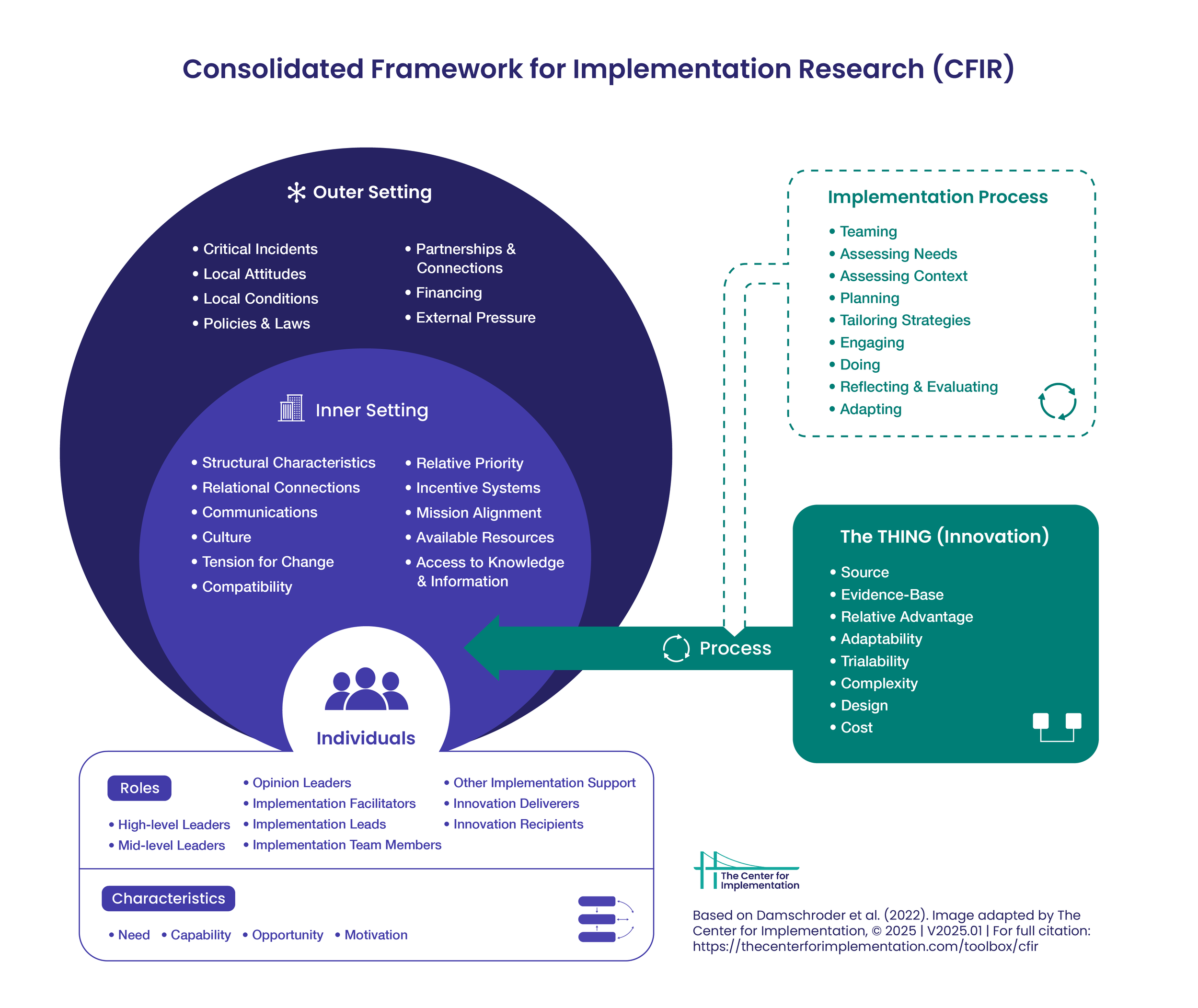
The TDF focuses predominantly on individual-level barriers and facilitators, with one domain to capture contextual barriers and facilitators called environmental context and resources, but this one domain is meant to represent the many contextual factors that could be impacting implementation. Therefore, to capture the combination of individual- and contextual-level barriers and facilitators in greater detail, combining the TDF and the CFIR makes sense. There are even academic articles written about this combination (Birken et al., 2017).

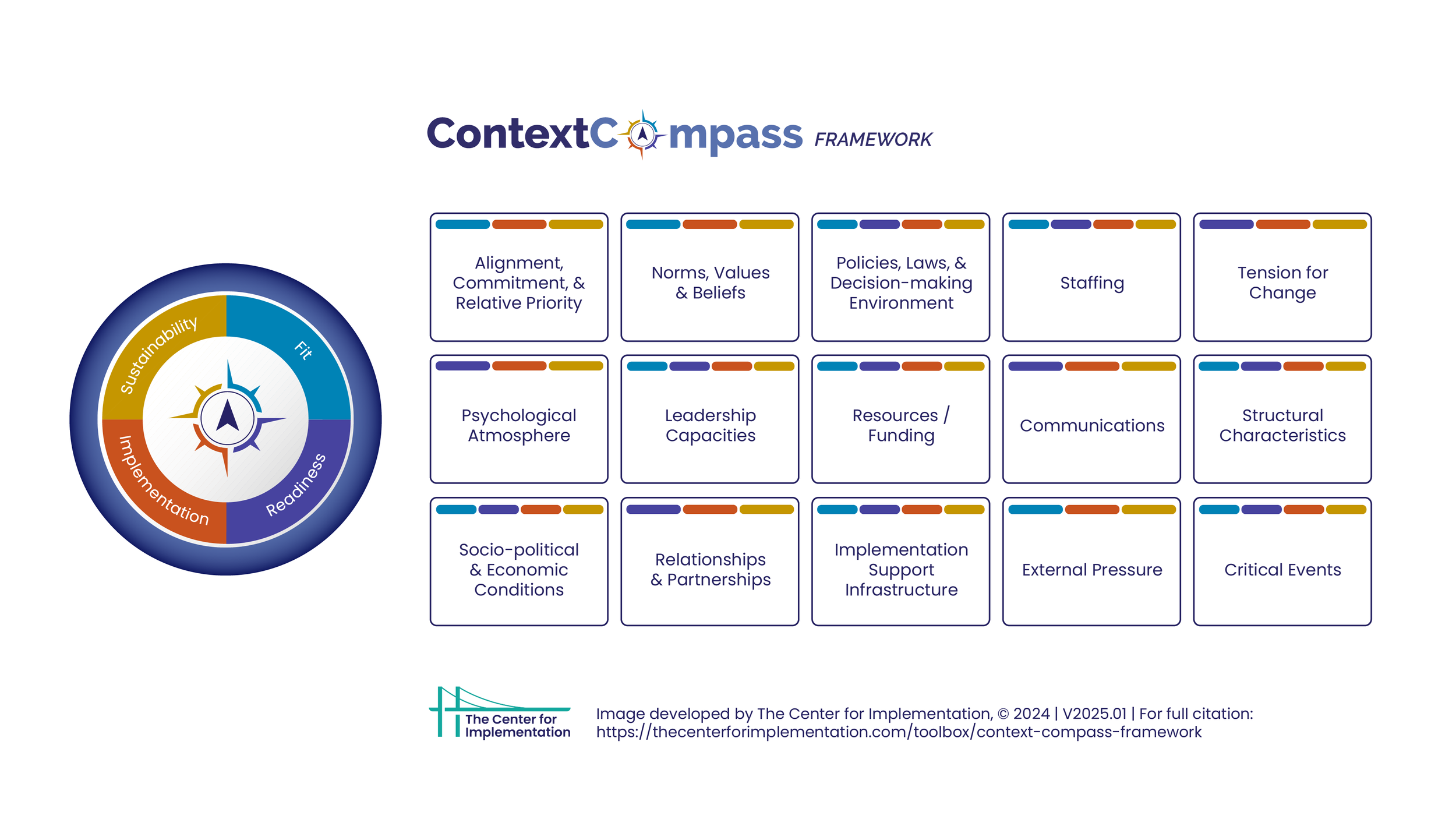
While the CFIR is the most used determinant framework, another contextual determinant framework can be combined with the TDF. We use the Context Compass Framework (CCF), a meta-framework that includes constructs from the CFIR as well as other contextual frameworks, as our primary contextual-level determinant framework for many different reasons — you can read about the Context Compass Framework here. The combination of an adapted version of the TDF and the CCF forms the basis of our StrategEase 2.0 Advanced tool — we have found that this combination made it easier to identify multi-level change strategies across multiple implementation phases or activities.
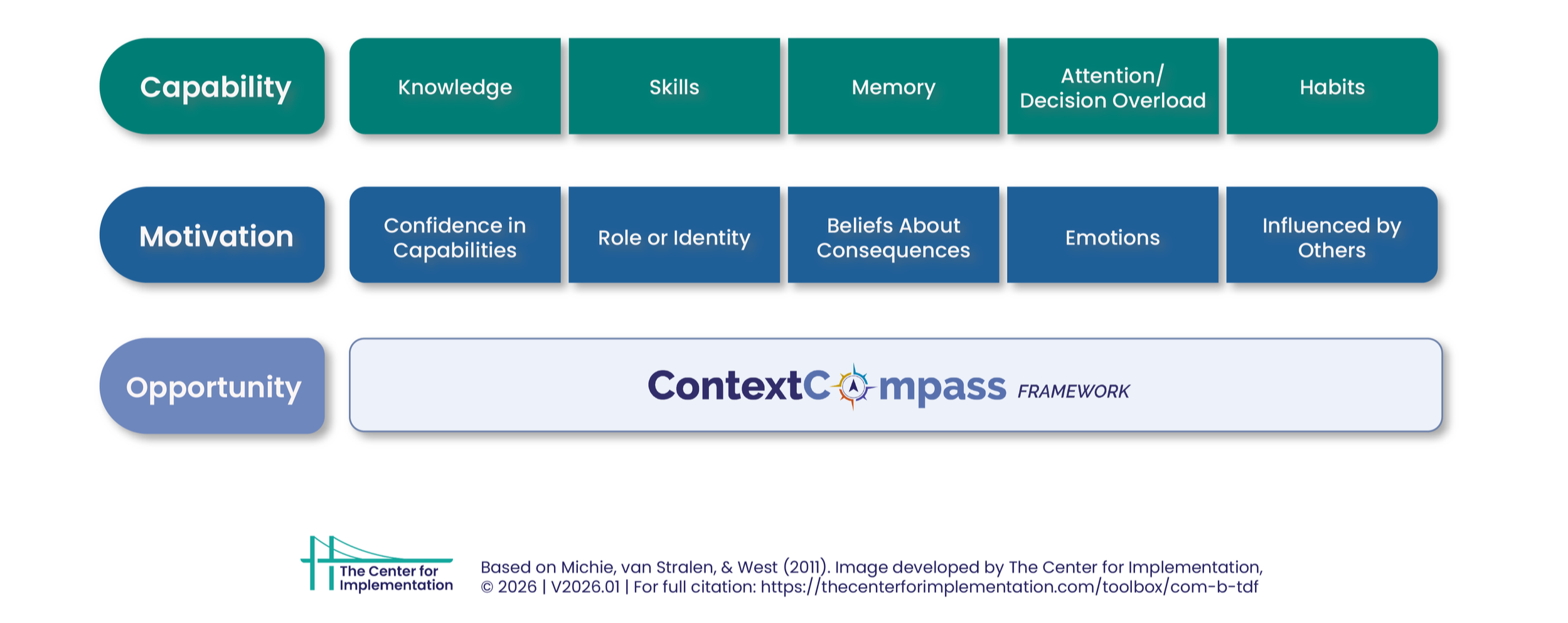
In our adapted version, we kept Capability and Motivation and replaced the Opportunity domain with the CCF, a contextual framework. You can read about what changed and why in the adapted Theoretical Domains Framework.
If you already use the CFIR, our crosswalk from the CFIR to the CCF shows how the two compare. This combination is also built into the StrategEase 2.0 Advanced tool, which uses the adapted TDF and lets you explore strategies for contextual barriers and facilitators using the CCF.
Tips for combining TMFAs
Since combining TMFAs is becoming more common, we thought we’d share a couple of our tips.
Be clear about what each TMFA is doing. You want to know the function it serves and how it is being used. A common problem we see is that people are combining TMFAs without really understanding the function that they are serving, and they end up with combinations that don’t clearly fit together.
Avoid picking TMFAs that have a lot of overlap. Sometimes people select two different TMFAs that have a lot of overlap in terms of their functions or the content of the TMFAs. This results in redundancy. Ideally, you want to pick TMFAs that either serve different functions or, like the TDF and CCF, serve the same function but have relatively little overlap in terms of their constructs.
Be explicit about why you are combining TMFAs. We’ve been seeing more examples of people picking popular TMFAs and saying they are combining them, without explicitly describing why or how.
Remember the goal of TMFAs is to add clarity, not complexity. TMFAs are sensemaking tools, so if combining them makes things more confusing, not less confusing, it’s probably not the right move.
In your implementation work, it is likely that you are going to have to select and use multiple TMFAs together, and that sometimes you will have to combine them. Here, we described how to combine different TMFAs to understand multi-level barriers and facilitators more comprehensively. There are other examples of combining TMFAs to fulfill other functions (such as RE-AIM and Proctor’s Implementation Outcomes Taxonomy for evaluation) that can be relevant to your implementation work. To support you in this, we encourage you to check out our TMFAs Navigator Tool and the TMFAs in Action Toolkit.
This article was featured in our monthly Implementation in Action bulletin! Want to receive our next issue? Subscribe here.